Litex is a formal language developed as a hobby since 2024. It is still in beta, and you may encounter issues.
Litex
The Formal Language Where Math Verifies Itself


“Truth is ever to be found in simplicity, and not in the multiplicity and confusion of things.”
What is Litex?
Litex is an experimental formal language for mathematics, started in 2024. Its source expresses definitions and proofs through familiar sets, functions, and explicit mathematical facts.
Set theory
Cantor's diagonal argument
For any proposed function f from a set S to its power set, form the diagonal set of elements x that are not in f(x). If f reached every subset, it would reach that set at some a—forcing a to be both in and not in f(a). The whole argument is runnable and checked, with no user-written trust fence.
01
Fact-oriented
Write the next mathematical fact.
The checker searches the available context for a local justification.
02
Set-theoretic
Keep mathematical objects readable.
Domains and conditions stay explicit in the source.
03
Mathematical workflow
Explore, check, keep, and reuse.
Work interactively in a Session or organize definitions and proofs in project files.
04
Human–AI feedback
Advance through explicit feedback.
Machine-readable results identify accepted steps and failed obligations.
05
Lean integration
Work toward independent rechecking.
Ongoing work on translating supported Litex proofs into Lean.
Writing mathematics in Litex
Define the objects in your problem, then state the intermediate facts that lead to your conclusion. Use the feedback to correct a step that cannot yet be checked.
Objects · small foundations

“Geometry, like arithmetic, requires for its logical development only a small number of simple, fundamental principles.”
Start with familiar sets, elements, and functions, with their mathematical conditions visible.
Relations · visible connections

To understand is to see connections.
AI-assisted mathematics should deepen human understanding. Litex's JSON records why statements were accepted, the rules and premises used, and the facts cited. Tracing these dependencies helps readers see how definitions and results connect, examine assumptions, and recognize where a proof can be reused.
Formalization that follows your mathematical workflow.
Edit the Newton example below, then inspect its verification record and knowledge graph.
Define an idea
Name the objects and make their mathematical conditions explicit.
Try and check
Test concrete examples, read the feedback, and revise the next step.
Keep useful results
Accepted statements leave knowledge for later reasoning within their scope.
Reuse and communicate
Keep definitions and theorems in project modules; use results in calculations or write them up.
Think, write, and check as you go.
Define a reciprocal, inspect why zero is rejected, and continue in the same Session.
litex> have fn f(x R: x != 0) R = 1 / x
success
litex> f(2) = 1 / 2
success
litex> f(0) = 0
Failed: input 0 does not satisfy x != 0.
litex> f(4) = 1 / 4
success
Keep today's results for the next exploration.
Prove the Newton fixed-point theorem in newton.lit, then apply it to √2 from example.lit.
release obj def newton::newton_sqrt_two
release thm newton::fixed_point(sqrt(2))
View the project files · definition, proof, and configuration
claim:
    ? forall x R+:
        (x + 2 / x) / 2 $in R+
    2 / x > 0
    x + 2 / x > 0
    (x + 2 / x) / 2 > 0

have fn newton_sqrt_two(x R+) R+ = (x + 2 / x) / 2

thm fixed_point:
    ? forall x R+:
        x^2 = 2
        =>:
            newton_sqrt_two(x) = x
    x = x * x / x = x^2 / x = 2 / x
newton_sqrt_two(x) = (x + 2 / x) / 2 = (x + x) / 2 = x[export]
newton = "./newton.lit"
example = "./example.lit"Put supported computations to work in Python or C, write up the mathematics in LaTeX, and follow the ongoing Lean integration for independent rechecking.
Read, run, and connect the resultsHow Litex works
Small checking steps return explicit evidence about the rules and premises used. These records explain a result and provide a route to Lean replay.
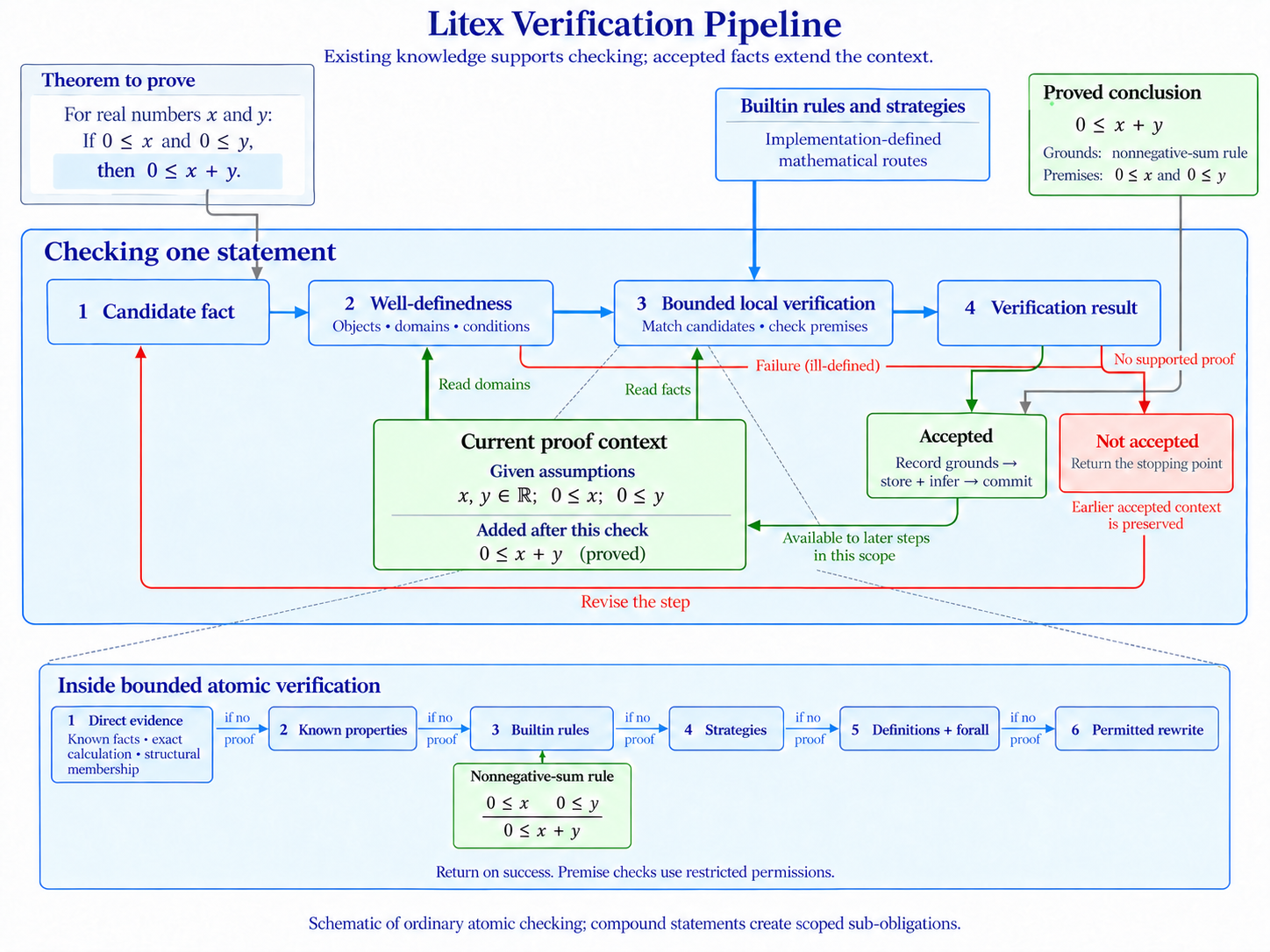
An overview of checking an atomic fact: read the current knowledge, check that expressions are meaningful, and look for supported local grounds. Accepted facts extend the context; an unsuccessful check returns its stopping point while preserving earlier accepted knowledge.
Open original English diagramSmall steps. Clear evidence. Replayable proofs.
A long proof can consist of small, explicit checks: the goal, the rule used, and its premises. Each successful step returns this evidence to the calling step.
Each supported builtin rule records its name, arguments, and premise proofs. Mapping these local steps to checked Lean theorem applications or tactic sequences provides a route to replaying the complete proof.
The structured execution results supply the evidence for JSON explanations and Lean replay. Lean integration is ongoing; each verification route needs a faithful, checked Lean mapping.

“The best way to predict the future is to invent it.”
Litex Goals
Our goal is a Python for formal languages: familiar mathematical writing with a lower learning barrier.

“What I cannot create, I do not understand.”
Math for AI
Give AI a language for checkable mathematical work. AI proposes; Litex checks; accepted knowledge accumulates.
Build an agent loop around one live Litex Session.
Give the agent a mathematical task, load the relevant context once, and let it propose one complete statement at a time. Verification feedback determines whether to keep the result or repair the pending statement.
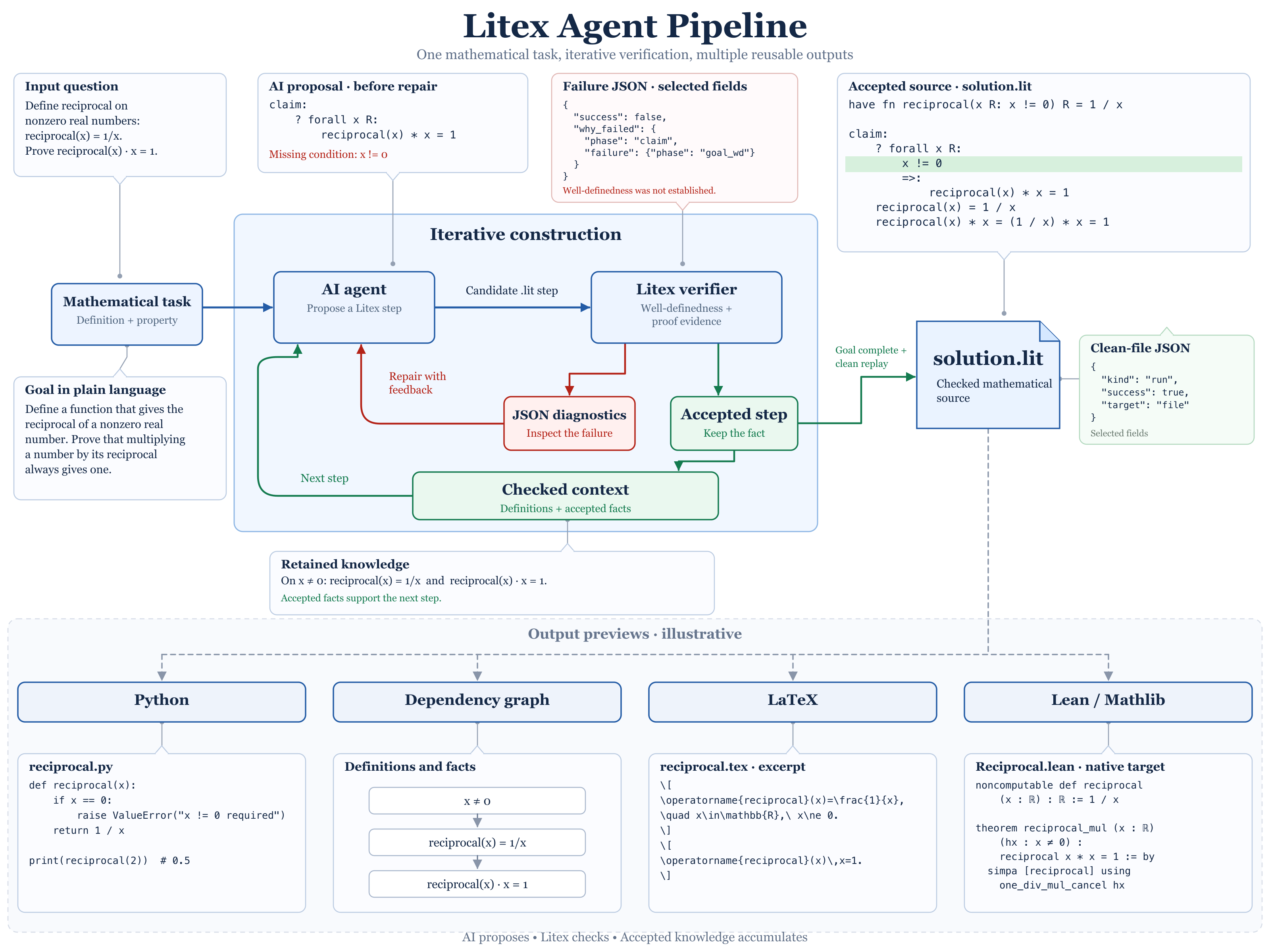
One reciprocal problem, from an AI proposal through verification and repair to reusable mathematics. The output previews illustrate possible uses of the checked source.
Define the reciprocal on nonzero real numbers and prove that multiplying it by its argument gives one.
01 · Load context
Understand the task and load its interfaces once.
The task asks for a reciprocal on nonzero reals. Start one terminal Session and make that domain explicit in the function definition.
have fn reciprocal(x R: x != 0) R = 1 / xsuccessThe reciprocal definition is available in this Session. The agent records this accepted source before proposing the next statement.
Accepted
Journal the source and continue from the enlarged context.
Ordinary failure
Keep the live Session, inspect the missing grounds, and repair the pending statement.
Stopped Session
Record the error, reopen the intended context, and replay the accepted prefix.
A claim and its nested proof form one statement. A multi-statement frame can partially commit: record each response before retrying. Failure is not proof of a proposition’s negation.
The terminal prints success for accepted statements and JSON diagnostics for failures. Clean file runs return JSON receipts. This recorded example illustrates the protocol; the website playground runs files separately.What is next?
Keep the same mathematical work useful beyond the current problem: write it up, run a supported computation, and connect to other tools. LaTeX and Python outputs are available today; Lean integration is ongoing.
Litex to LaTeX.
Turn mathematical definitions, facts, and proof steps into LaTeX for papers, notes, and teaching. Here the distance-from-zero example becomes a definition, a general fact, and a concrete calculation.
have fn distance_from_zero(x R) R = abs(x)

forall x R:
    distance_from_zero(x) = abs(x) >= 0

distance_from_zero(-3) = distance_from_zero(3) = 3Definition distance_from_zero.
Let .
For every , we have .
From checked mathematics to executable code.
A supported computational definition can become runnable Python. Here is the Newton update from our earlier example, with an explicit restart at zero.
algo newton_step(x R) R by cases:
    case x = 0: 1
case x != 0: (x + 2 / x) / 2def newton_step(x):
if x == 0.0:
return 1.0
elif x != 0.0:
return ((x + (2.0 / x)) / 2.0)
raise AssertionError("unreachable verified Litex cases")Executed: 1.0 → 1.5 → 1.4166666667.
Experimental extraction for supported numeric definitions, with Python and C99 targets. Generated code uses floating-point arithmetic.View Python / C extraction on GitHubLitex to Lean.
We’re developing compilation from supported Litex proofs to Lean for independent rechecking.
1 = 1import Litex
theorem __fact0 : Litex.Same (1 : ℂ) (1 : ℂ) := by
exact Litex.Same.refl (1 : ℂ)Mathematics textbooks, from school to university.
We plan to build a complete Litex mathematics curriculum, gradually covering primary and secondary school mathematics and core undergraduate subjects. Definitions, proofs, and worked examples will become knowledge learners can check, understand, and reuse.
Explore mathematicsA wider horizon
Beyond the Search for One Best Language
“Mathematics is the queen of the sciences.”
— Carl Friedrich Gauss
Mathematics is the mother of the natural sciences. Alongside Lean, Mizar, Isabelle, and Rocq, Litex explores a new design perspective: familiar ideas brought together around a readable, fact-oriented interface.
In tactic-oriented workflows, authors describe how to build a proof. Litex starts from what should hold and lets the verifier seek a justification in context. Such reversals of the starting assumptions guide many of its design choices.
Compare Litex and Lean through examples →As AI helps more people use mathematics, formalization could follow it into more disciplines. Litex aims to lower the learning barrier so more people can understand and use checked mathematics in science and engineering. We believe formal mathematics has more than one possible future.
Community and support
Litex grows with its community.
Researchers, users, friends, and partner organizations help make Litex possible.
“If I have seen further, it is by standing on the shoulders of giants.”
Sponsors and partners



What people say
How readers describe Litex
“From knotted cords to symbolic notation, the choice of representation has always shaped human thought. Arabic numerals and Newton's calculus notation prevailed because of their clarity and simplicity. As formal languages evolve today, Litex may likewise open new possibilities by enabling us to reason clearly, simply, and formally.”
Zeyu Zheng
PhD Candidate at CMU“The only language capable of verifying advanced arguments using the mathematical notation familiar since elementary school.”
Yuniruyuni
Math Lover from Japan“I appreciate a serious contender in the field of interactive theorem proving. Currently the field is dominated by Lean and Rocq, and I appreciate that Litex is challenging this duopoly.”
Huỳnh Trần Khanh
Lean Expert from Vietnam“Litex is a hacker-built, community-driven, and highly creative project that brings value to everyone working on AI and mathematics.”
Siqi Sun
CTO of Intelligen, Research Scientist at Shanghai AI Lab and Fudan University“I'm a happy researcher dedicated to making AI more trustworthy and protective of humanity. Litex is the formal language that can help align AI reasoning with human understanding in this big AI dream!”
Jie Fu
Yoshua Bengio's Postdoc“Litex is much easier to use compared to other formal languages like Lean. While it is still in its infancy, I believe it has the potential to become a powerful research tool that every scientist will be able to easily use and be eager to adopt in the future.”
Yan Lu
Research Scientist at Shanghai AI LabWith gratitude
Built in conversation.
Special thanks to Wei Lin, Siqi Sun, Peng Sun, Yi Wang, Chenxuan Huang, Yan Lu, Sheng Xu, Keyao Zhu, Xingjian Ma, and Zhaoxuan Hong for their support and advice.